"When the first baby laughed for the first time, the laugh broke into a thousand pieces and they all went skipping about, and that was the beginning of fairies." (from Peter Pan)
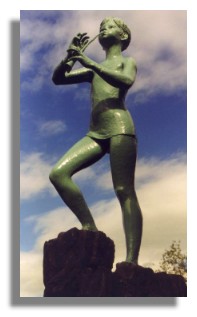
Barrie became world famous with his play and story about PETER PAN (1904), the boy who lived in Never Land, had a war with Captain Hook, and would not grow up.
When Barrie was seven, his brother David died in a skating accident. David had been the mother's favorite child, and she fell into depression.
"One day Jamie's oldest sister, Mary, desperate for a solution, told Jamie to go to his mother's bedside and tell her she still had another boy. Jamie entered the dark room and stood there fearful as no sound came from the bed. Suddenly he heard a listless voice saying, 'Is that you?' The tone hurt Jamie, so he gave no reply. Again, 'Is that you?' Convinced that she was speaking to her dead son, Jamie replied, 'No, it's not him. It's just me.' He heard his mother turn over and cry." -http://www.rci.rutgers.edu/~ogilvie/margaret.html
Barrie tried to gain her affection by dressing up in the dead boy's clothes. The obsessive relationship that grew between mother and son was to mark the whole of his life.
One day a friend of his quoted these lines from Cowley;
"What can I do to be forever known,
And make the age to come my own?"
Inspired by the passage, Jamie hurried home and repeated the lines to his mother. In jest, he asked her if that is the kind of person she would like to be. Margaret replied, "No, but I would be windy of being his mother."
Robert Sapolski, Professor of Biological Sciences and Neuroscience at Stanford University, argues that Jamie Barrie seized upon the idea that by remaining a boy forever, "by not growing up, he will at least have some chance of pleasing his mother, winning her love. Although there is no evidence of disease or malnutrition in the well-to-do family, he ceases growing. As an adult, he is barely five feet in height, and his marriage is unconsummated." With this example in hand, Sapolski describes the growth-stopping physiological mechanisms triggered by stress that can result in the rare condition of stress dwarfism.
"Psychogenic dwarfism (also known as 'garbage can' syndrome) is a growth disorder that is observed between the ages of 2 and 15, caused by extreme emotional deprivation. The symptoms include decreased growth hormone (GH) secretion, very short stature, weight that is inappropriate for the height, and immature skeletal age. This disease is a progressive one, and as long as the child is left in the stressing environment, his or her cognitive and linear abilities continue to degenerate." -Physical Development in Early Childhood

His classmates Barrie observed like an outsider, they were tall, interested in girls, while he remained small and apparently he never had a girl friend.
Barrie knew such great figures of literature as G.B. Shaw and H.G. Wells. Once he said to Wells: "It is all very well to be able to write books, but can you waggle your ears?" When a friend noticed that he ordered Brussels sprouts every day, he explained: "I cannot resist ordering them. The words are so lovely to say."
 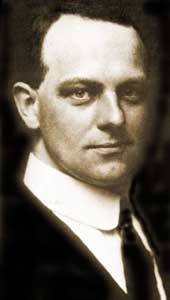 
With his friends, Jerome K. Jerome, Arthur Conan Doyle, P.G. Wodehouse and others, Barrie founded a cricket club, called Allahakbarries. Doyle was the only member who could actually play cricket. During World War I Barrie made a western film with his literary friends, starring Shaw, William Archer, G.K. Chesterton, etc.
In 1894 he married Mary Ansell. According to Janet Dunbar's biography (1970), Barrie was impotent. "Boys can't love", was Barrie's explanation to her.

"Every time a child says 'I don't believe in fairies' there is a little fairy somewhere that falls down dead." (from Peter Pan)
Peter Pan evolved gradually from the stories that Barrie told to Sylvia Llewelyn Davies's five young sons. When Davies and her husband died, Barrie was the unofficial guardian of their sons, but in reality he was perhaps more a sixth child than an adoptive father. George, one of the sons, died in World War I, Michael drowned himself with his boy friend in Oxford. Michael's death was a deep blow to Barrie. Peter, who become a publisher, committed suicide in 1960.
|


Recent Comments