13 YEARS AGO TODAY

Oct 20 1991
October 20 will be remembered as the date of one of this nation's most costly fires; the worst fire involving loss of life and property since the Great San Francisco Earthquake and Fire of 1906.
The magnitude and scope of what is simply referred to as the "Tunnel Fire" or "Oakland Firestorm" is far beyond the experience of any living American firefighter. Only those who fought the Chicago Fire last century or battled the Great Fire in San Francisco would be able to identify with this conflagration and firestorm.

"This was a house on Skyline. It had the driveway and garage on top, with the house below."
The origin of the fire was on a steep hillside in what some have called a box canyon above state Highway 24. This is a wooded area with heavy underbrush, narrow streets and steep terrain. The unusual weather conditions are described as follows: "...an unusual east wind, at speeds in excess of 65 miles per hour, that raced down from the crest of the Oakland-Berkeley Hills. Coupled with record high temperatures well into the nineties, the hot, dry winds gusted and swirled through five years of drought-dry brush and groves of freeze-damaged Monterey pines and eucalyptus trees."
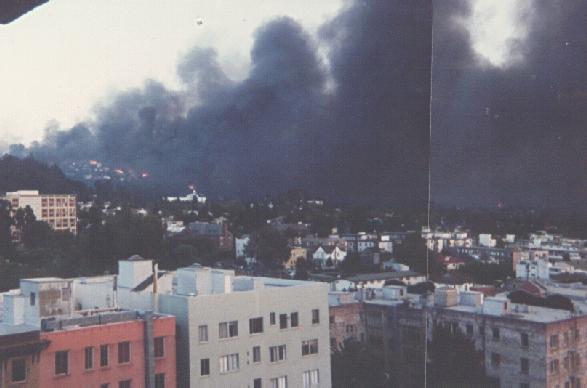
" you can see several houses burning on top of the left hill, and a glimpse of the flames on the right side, beyond the seam. The fire area covered almost the entire width of this picture. I watched from the window of my dorm as the fire advanced down the hill, burning one house after another."-Lucas Periera
More than 25 firefighters were on the scene overhauling hot spots from a fire the previous day. It is important to note that Saturday's fire had been well overhauled; hose lines were left in place surrounding the burn area, the fire area was checked by Oakland fire companies during the night, and fire crews had been on the scene hours before ignition on Sunday.
Eyewitness accounts testify that a sole ember blew into a tree just outside the burn area, and the tree exploded into flame, and the resulting fire was quickly out of control -- raging around and over firefighters who were indeed fighting for their lives.
Rescue and evacuation efforts were made as firefighters were forced to fall back to defensible space.
A request for additional fire units and air drops were immediately called for. Soon, streets were clogged with residents trying to get out, sightseers and emergency personnel trying to get in.

The fire quickly established four fronts, west downhill toward state Highway 24 and the Rockridge District, north toward the Claremont Hotel, south toward Broadway Terrace and east toward Contra Costa County.
Oakland firefighters were assisting with evacuation efforts as they were forced to retreat from the advancing inferno. Division Chief Riley and Oakland Police Officer John Grubensky were killed while trying to help citizens escape the fire. Both Chief Riley and Officer Grubensky were found with the remains of those people they were trying to help.
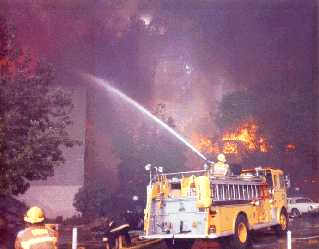
There were many problems that confronted both line firefighters and managers as the fire progressed.
Water Supply
Fire units lost water, forcing them to retreat because the supply tanks and reservoirs were emptied. Loss of water occurred primarily because of:
- Fire suppression efforts
- Citizens wetting roofs and vegetation
- Water service flowing freely in destroyed homes
- Tanks and reservoirs could not be refilled because of fire-caused electrical failure
- Many mutual aid fire engine companies could not connect to Oakland fire hydrants because they utilize two-and-one-half- inch hose couplings and Oakland fire units use three inch couplings
Mutual Aid
Requests for mutual aid in the form of air support and fire suppression units were made.
- Seventy-four type-one strike teams [five engines each]
- Aircraft from hundreds of miles away made hundreds of water and retardant drops
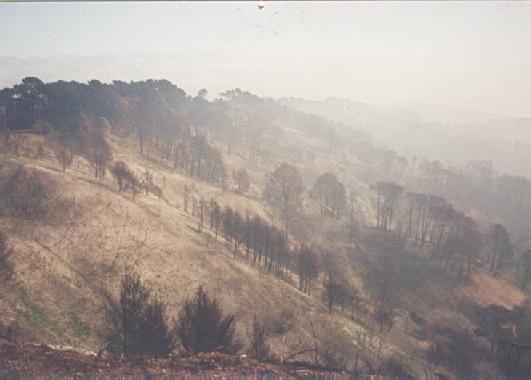
"A view from Tunnel Road shows a whole hillside charred barren by the flames."
This was the largest mutual aid effort ever undertaken in the State of California.
Communications
Radio communications were often difficult or impossible because:
- Overload (too many units on the same channel)
- Too few mutual aid channels available
- Steep, hilly terrain interfered with radio signals

Fire Statistics
Deaths.......................................................................................25
Injuries....................................................................................150
Single Family Dwellings Destroyed..........................................2,843
Single Family Dwellings Damaged.................................................193
Apartment Units Destroyed..............................................................433
Total Living Units Damaged or Destroyed..............................3,469
Total Acreage Burned by the Fire..............................................1,520
Fire Perimeter................................................................5.25 Miles
Estimated Dollar Fire Loss......................................$1,537,000,000
Capt. Donald R. Parker
-http://www.sfmuseum.org/oakfire/overview.html





Recent Comments